
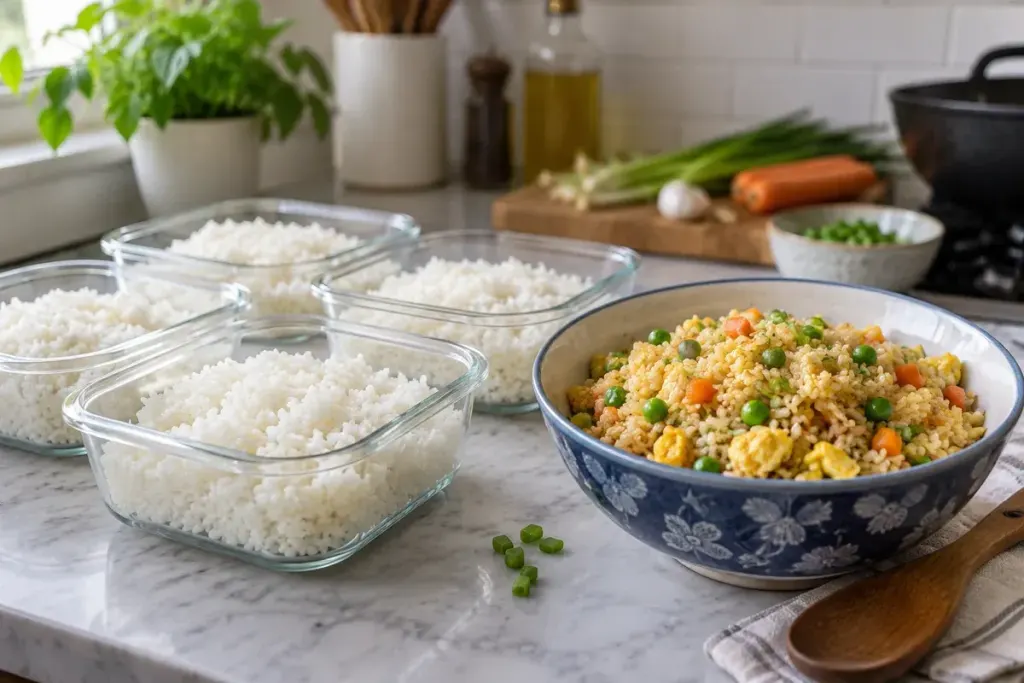
“Use yesterday’s rice” is common fried-rice advice, but the date alone does not make a good ingredient. Rice left in a deep pot on the counter is not a useful shortcut. What matters is how it was cooked, cooled, stored and handled before it reaches the pan.
For a simple egg-and-vegetable version, think of the rice as a prepared ingredient rather than an afterthought. A little organisation gives you a calmer cooking session and makes it easier to separate the grains without crushing them.
Cooling is a food-safety step
Divide rice intended for later use into small, shallow containers and refrigerate promptly. Do not wait for a large pot to cool for hours. The USDA’s leftover-storage guidance recommends shallow containers for rapid cooling and refrigeration within two hours, or one hour when conditions are above 90°F/32°C. Follow stricter local rice-specific guidance where applicable.
Keep the refrigerator at the recommended safe temperature and label the container. If you do not know how the rice was stored, choose another batch. Reheating is not a way to make badly stored food reliably safe.
Separate the preparation from the frying
Before turning on the heat, loosen clumps gently with clean utensils. Dice vegetables to a reasonably consistent size, beat the egg in a separate bowl and put the seasonings within reach. A crowded board is manageable; a crowded hot pan is much harder to correct.
Choose additions that fit the rice rather than emptying the refrigerator into one meal. For a small household batch, egg, peas, finely diced carrot and spring onion provide different textures without requiring several competing cooking times. Adjust the ingredients to dietary needs and what you can handle safely.
Give the pan room to work
If your pan is small, cook in batches. Prepare ingredients that need longer cooking first, move them to a clean dish, and combine them with the rice when appropriate. Wet vegetables and a large pile of cold rice can turn a frying session into steaming.
Add sauce gradually. You can distribute a small amount across the rice more easily than remove an excess. Taste only food that has been cooked safely, using a clean utensil, and remember that different soy sauces have different salt levels.
Serve a finished meal, not a storage experiment
Reheat leftovers thoroughly; USDA guidance gives 165°F/74°C as the safe reheating temperature. A food thermometer is more dependable than judging warmth at the edge of the pan. Make an amount you expect to serve, and follow local guidance for any remaining food.
The best improvement may happen long before the wok becomes hot: a shallow container, a clear storage time and a prepared set of ingredients. Separate grains are a cooking goal; safe handling is what makes those grains worth serving.