
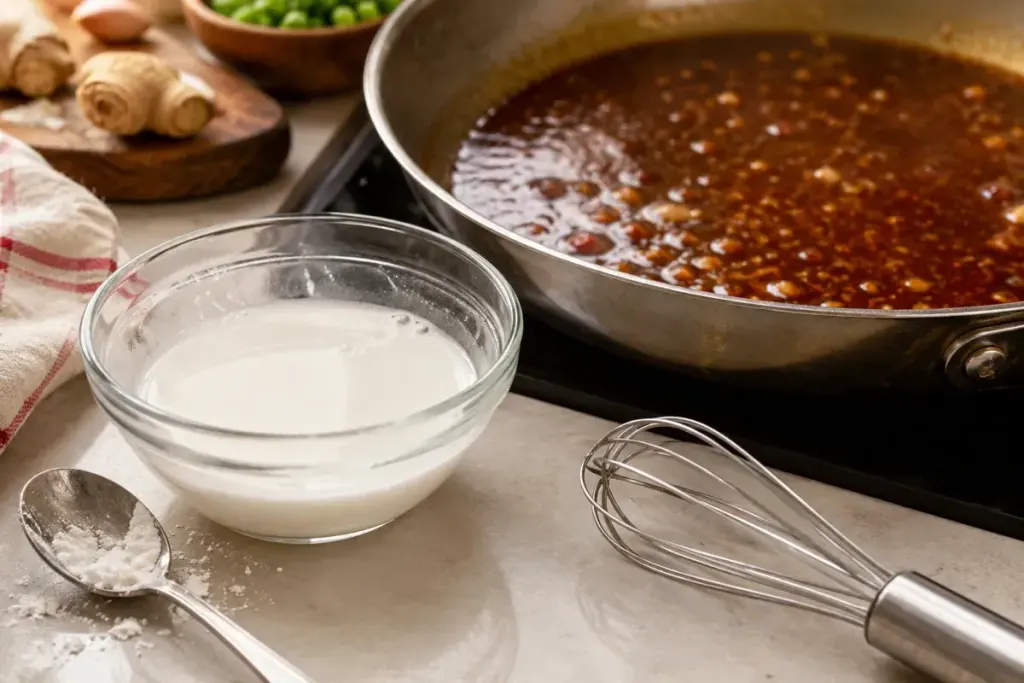
A sauce can move from glossy to gluey surprisingly quickly. The simplest way to keep control is to treat a prepared slurry as an amount you may use, rather than an amount you must empty into the pan.
In Chinese cooking, cornstarch has several jobs. Here we are discussing thickening a sauce at the end of cooking, not coating meat or making a batter. The Woks of Life’s cornstarch guide explains mixing starch with water before it enters a hot sauce, stirring it again after it settles, and adding it while stirring.
Keep the powder out of the hot sauce
Measure the cornstarch and cool liquid called for in your chosen recipe into a small bowl. Mix until there are no dry pockets. Dry starch tipped directly into hot liquid can form lumps that are difficult to distribute evenly.
Leave a spoon in the preparation area so you remember to stir the slurry immediately before use. A bowl that looked uniform when you made it may have a settled layer by the time the vegetables are ready.
Decide what the sauce should do
“Thick” is not a very useful target on its own. For a vegetable stir-fry, you may want a light coating that clings to the ingredients. For a different dish, the recipe may intend more body. Look at its photographs and instructions before deciding that a thin sauce needs correcting.
As the hot sauce reaches the stage specified in the recipe, add a small portion of the freshly stirred slurry and mix it through. Give the starch time to cook and thicken before deciding whether more is needed. The liquid released by vegetables also affects the result.
A troubleshooting pause
- The sauce looks thin immediately after adding slurry
- Check that it has reached the recipe’s cooking stage. Do not respond with another large pour before the first addition has had a chance to work.
- The sauce has become heavier than intended
- A little compatible hot liquid may loosen it. Add gradually and reassess the seasoning; dilution changes flavour too.
- Lumps appear
- For the next batch, examine the slurry before adding it and keep it moving as it enters the sauce. Do not hide the problem beneath more starch.
Record the adjustment, not just the recipe
Note how much prepared slurry remained and whether the vegetables released much water. Those observations can explain why the same recipe behaved differently on another evening. They are not a reason to assign one fixed ratio to every dish.
For a complete meal to practise with, choose a tested stir-fry recipe and organise the ingredients using our preparation workflow. Sauce control becomes easier when the rest of the pan is ready.